Low Light, Long Thoughts: Starting a New Painting Series in the November Studio
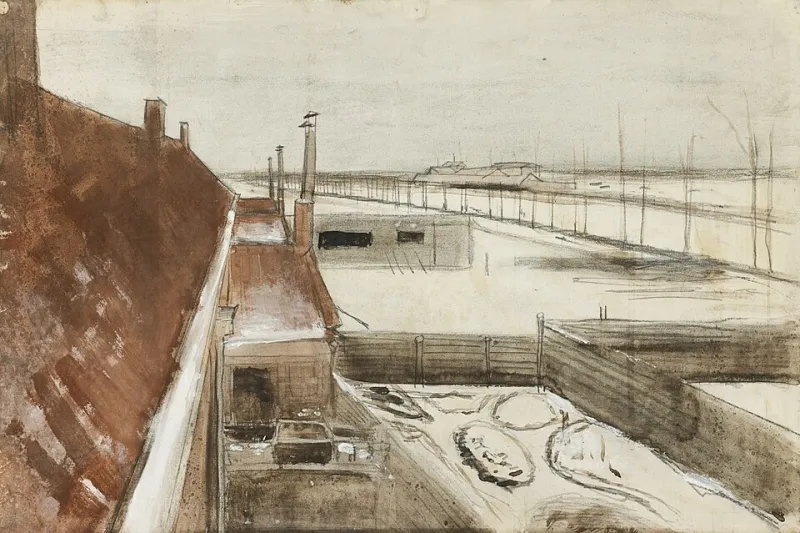
Photo: Vincent van Gogh, Public domain, via Wikimedia Commons
There is a moment in late October when the studio stops feeling like a place to finish things and starts feeling like a place to begin them. The light drops earlier, the heating clicks on, and the diary thins out. By the time November arrives in the UK, I am usually less interested in tidying up old ideas than in clearing a wall and starting a new body of work.
That is not a romantic claim about gloomy weather. It is practical. Winter changes the pace of the studio, and for anyone who wants to understand how paintings develop before they reach a gallery, November is a good month to watch.
Why November suits the beginning, not the end
Summer is noisy. Even when you are working, there are windows open, people to see, shows to visit and a lingering feeling that you should be outside. November removes some of that pressure. The studio becomes a room you want to be in rather than a room you feel guilty about leaving.
The other advantage is psychological. A new body of work needs a bit of unprotected time. If you start in spring, there is often an exhibition deadline or a fair looming by the time the paint is barely dry. Starting in November gives the work a few months to sit, fail, change and settle before anyone else sees it.
At Robert Mee Artist, the winter studio is where the scribbles on the back of envelopes start turning into something that can be pinned to a wall. It is not glamorous. There are cups of tea going cold, a radio doing the same, and a lot of standing back with folded arms.
Light: work with what you have, then correct it
UK daylight in November is short and often grey. That is not automatically a problem. A flat, cool light can be useful for judging tone, because it does not flatter warm colours the way low afternoon sun does. But it is not reliable enough to work by all day.
A north-facing window is still the quietest light in the building, but most studios do not have one. Practical fixes are simple. Move the easel so the light falls across the work rather than straight onto it. Avoid working with a window behind you, which turns the painting into a silhouette. Keep a black cloth or a sheet of grey board nearby to check values.
For artificial light, a decent daylight lamp in the 5000K to 6500K range is more useful than guessing under a household bulb. Look for a high colour rendering index if the packaging gives one, and try not to mix tungsten and daylight in the same corner. If your blues look purple at 4pm, the lamp is probably the problem, not your palette.
I also keep a small battery-powered clip light for photographing work in progress. It is not a studio light, but it helps document a surface when the sun has gone and you want a record of what changed.
A routine that protects the work
Winter routines should be boring in the best way. I like a three-hour block in the morning for anything that needs a clear head: drawing, colour mixing, starting a canvas or making a tonal study. Admin, emails and framing orders can wait until the light is worse.
The temptation in November is to work longer because it feels dark anyway. That is usually a mistake. Tired eyes make muddy decisions. A short afternoon session with a specific job is better than three vague hours of hovering. I often set one task before lunch and one after: block in the ground, adjust the drawing, mix a limited palette, stop.
Heat matters too. A cold studio makes you tense, and tension shows up in the brushmarks. If you cannot heat the whole room, heat the corner you use. Keep drying paintings away from direct heat and open a window briefly when using solvents. Winter ventilation is less appealing than summer ventilation, but it is no less necessary.
What the first few weeks actually look like
A new body of work rarely begins with a finished composition. It begins with repeats. In November I might make ten small studies of the same shape, or mix a palette that I am not sure about yet, or paint the same corner of a room until it stops being a corner and starts being a subject.
This is the part collectors do not see in the final gallery hang. The first works are often provisional. They are tests for colour temperature, edge quality and scale. Some of them will be painted over. A few will become the skeleton of a larger piece. The useful thing is not to decide too early what the series is about.
By the end of the month, the wall usually tells me something. Three paintings might share a certain grey. A particular crop keeps appearing. A colour that looked wrong on its own suddenly makes sense next to a neighbour. That is the moment the body of work starts to have a pulse.
Notes from the wall
I keep works in progress on the wall rather than stacked in a rack. It is not always practical, but it is honest. A painting that looks fine on the easel can look stiff across the room. A painting that feels clumsy close up can hold a wall beautifully.
November is a good time to invite one trusted pair of eyes into the studio, not a crowd. Ask them what they notice first, not whether they like it. The answer is usually more useful than a compliment.
Keep a record before the work is finished
One habit worth starting now is documenting the messy middle. Photograph the drawing, the blocked-in colour, the first adjustment. These photographs are not for social media unless you want them to be. They are for you. They show how a painting arrived, and they make it easier to see whether the finished thing has kept the energy of the early stages.
By the time spring comes, the series will need editing, framing, pricing and perhaps a gallery conversation. November is for the part before all that: the quiet, awkward, useful beginning. The days are short, but the work has room to grow.