Show Me the Underdrawing: The Case for Seeing an Artist’s Working Mess

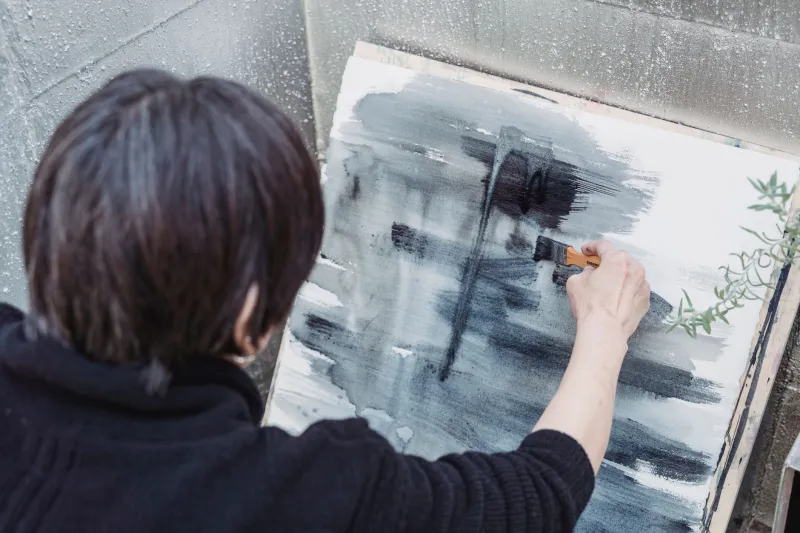
Photo by Photo by Kwami Fattah Al Sissi on Unsplash on Unsplash
A few years ago, I watched a collector fall in love with a painting in about four minutes. Not because of the finished surface—though it was lovely—but because the artist pulled out a scrappy charcoal study and said, 'That is where the whole thing started.' Suddenly the pale grey behind the trees made sense. The odd purple in the shadow stopped being a quirk and became a decision.
That is the argument for process over polish. A finished canvas is the press release. The sketches, underpaintings, colour notes and abandoned versions are the conversation. They tell you how the artist thinks, what they wrestled with and why the final image holds together—or deliberately does not.
The finished work is only half the story
Collectors often buy with their eyes and then ask questions afterwards. Fair enough. We all do it. But if you want a purchase to mean more than a nice thing above the sofa, ask to see the messy bits. An underpainting can reveal a completely different composition underneath. A rejected version can show the artist choosing restraint over noise. A sketchbook can prove that the looseness in the final piece was earned, not accidental.
This is not about romanticising struggle. It is about evidence. When you see the workings, you understand the work. You also get a better sense of whether the artist is developing or repeating themselves, which is useful whether you are buying your first print or your fifteenth painting.
What artists should share—and what to keep back
There is a difference between opening the studio door and turning the whole practice into content. Artists do not owe collectors every private notebook, every bad day, every half-formed idea. Oversharing can flatten the mystery and turn process into performance.
A good middle ground is to share selected evidence: one or two studies for a finished piece, a photograph of the underpainting, a short note about a colour that caused trouble. Keep the deepest experiments private if they are not ready. Protect commissions and client confidentiality. And please, do not post a time-lapse of every brushstroke and call it generosity. The point is insight, not volume.
Studio questions that tell you more than a caption
If you are lucky enough to visit a studio, or to catch an artist at an open studios weekend, ask questions that invite a real answer. Try these:
- What changed between the first sketch and the final painting?
- Which version did you abandon, and why?
- What is under this surface?
- Which colour gave you the most trouble?
- How did you know it was finished?
- What would you say to the version you painted out?
- Can I see the drawing that started it?
- How do you document works in progress?
These are better than 'How long did it take?'—though that can be interesting too. The answers give you a sense of the artist's eye, not just their hand. They also help you decide whether the finished piece is a one-off lucky hit or part of a genuine line of enquiry.
Why this matters for collecting
A collection built on conversation ages better than one built on impulse alone. When you know why a painting looks the way it does, you are less likely to fall out of love with it when the fashion shifts. You are also more likely to spot the artist's good work early, rather than waiting for a gallery to tell you what you are looking at.
In the UK, we are lucky to have a culture of studio visits, open studios, degree shows and village hall exhibitions where the gap between the artist and the collector is pleasantly small. Use it. Ask to see the drawing. Ask about the failure. Ask what is underneath. The messy bits are not a sales tactic—they are the working life of the thing you are thinking of buying.
The messy bits are not a demand
Some artists will welcome the question. Some will politely say no. Respect both. Process is not a product, and no collector is entitled to an artist's private experiments. But when an artist does share the workings, take the invitation seriously. It is a chance to see the painting as a set of choices rather than a finished object. That is usually the moment a purchase turns into a relationship.