A Wall of Small Victories: Why Pocket-Sized Paintings Are Filling British Homes
There is a particular kind of British wall that has never quite got its act together. It is the strip beside the front door in a Victorian terrace, the bit between the bathroom and the spare room in a new-build flat, or the narrow slice of wall above a radiator that nobody knows what to do with. For years, these spaces have been left to coat hooks and the occasional mirror. Lately, though, they have been filling up with paintings - small ones.
Not postcard reproductions or tidy little prints, but proper original works on board, canvas and paper. The kind you can carry home on the bus without rearranging the furniture. Small paintings are having a moment in British homes, and it is not hard to see why.
The room got smaller; the appetite didn’t
A lot of us are living in spaces that were not designed for statement art. Victorian terraces have hallways like corridors and chimney breasts that swallow whole walls. Modern flats are efficient with square footage and stingy with hanging space. Even a decent-sized semi often has a landing that is more thoroughfare than gallery.
A large painting can still work in those rooms, but it needs the right wall and a certain amount of commitment. Small works are more forgiving. They slot into the gaps. They let you live with original art without turning the sitting room into a one-painting exhibition.
The other thing that has changed is the way people collect. Plenty of collectors now buy steadily rather than saving for one big splash. They pick up a small piece at an open studio weekend, another at a degree show, another from a gallery in a town they were visiting for the day. Before long, they have a wall that tells a story rather than a single expensive object that has to carry the whole room.
That is not a lesser way to collect. In some ways it is a more serious one. You learn your own eye. You make mistakes at a lower price. You end up with range.
Why several small pieces can beat one big one
A single large painting is brilliant when it is brilliant. It gives a room a centre and a mood. But it also asks a lot of the wall, the light and the furniture around it. And if you fall out of love with it, you notice every day.
Several small works spread the risk and the pleasure. You can mix a quiet landscape with a looser abstract, a figure study with something more graphic. You can move them around when the room changes. You can add to the collection without needing to find another wall.
There is a practical point too. A collection of small originals often costs less than one large painting by the same artist. That means you can support more artists, buy at different stages of their careers, and build something that feels personal rather than purchased in one afternoon.
The trick is not to treat small paintings as minor. Buy them because they are good, not because they are cheap. Ask the same questions you would ask of a large work: who made it, when, what is it painted on, how should it be framed, and how should it be cared for.
Hanging patterns that actually work
Small paintings look best when they are given a bit of structure. A few loose arrangements that tend to work:
- The grid. Same-sized works, same frames, tight gaps of around 5-7cm. This is tidy without being fussy and works well in hallways and above desks.
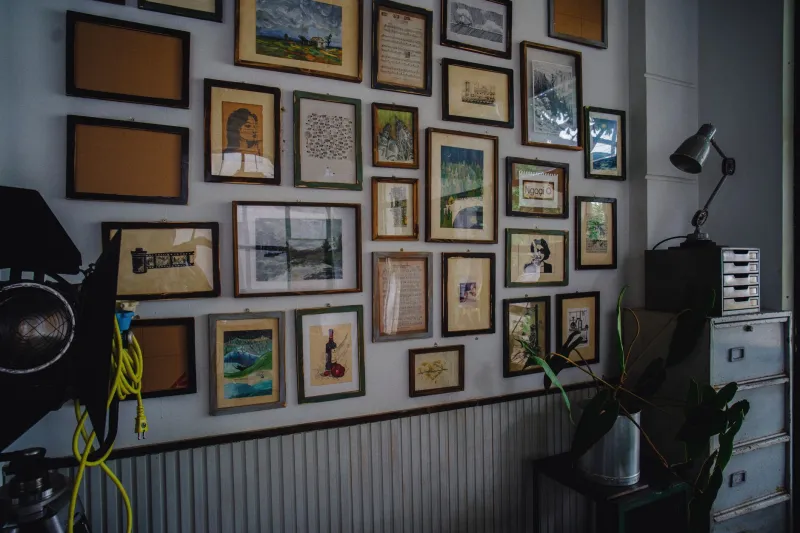
- The salon hang. Mixed sizes and shapes, built out from a central anchor piece. Lay them on the floor first or cut paper templates. Keep gaps consistent so it reads as one group rather than a jumble.
- The column. Two or three small works stacked vertically. Good for narrow walls between doors or beside a chimney breast. Align the centres and leave breathing room above and below.
- The picture ledge. No nails, no measuring drama. Particularly useful in rented flats. Swap works around when the mood takes you.
- The staircase run. Follow the rake of the stairs, but keep the gaps between frames even. Do not try to match the angle exactly with every frame; a steady rhythm looks better than a slavish diagonal.
As a rule, hang the centre of the group at roughly eye level - around 145-150cm from the floor is a decent starting point. In a hallway, leave at least 15-20cm either side of the group so it does not feel crammed into the corner.
Avoiding the postage stamp on a barn door
This is the classic small-painting problem. A 20cm canvas on a three-metre blank wall does not look minimal. It looks lost. The painting starts to apologise for itself, and the wall wins.
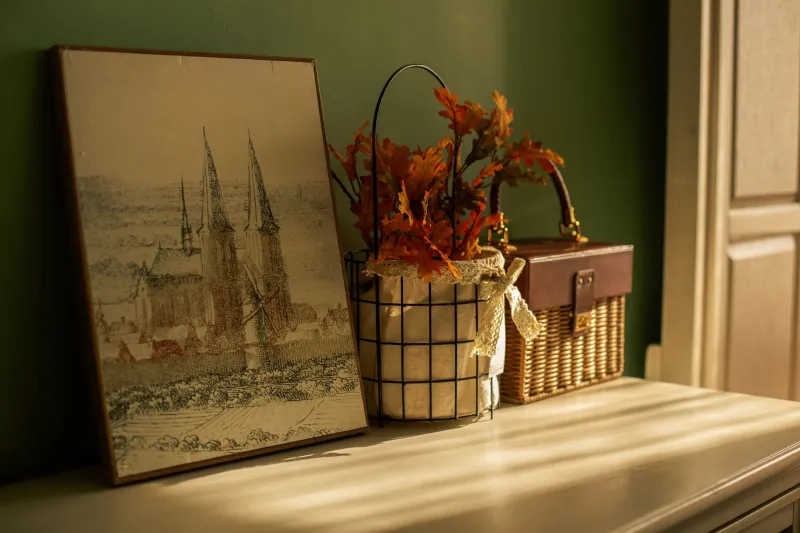
There are a few ways round it. Cluster the work with others so the group has weight. Use a wider mount or a slightly larger frame to give a small piece more presence. Hang it in a genuinely small space - the end of a hallway, above a narrow console, between two windows - where it can hold its own. Or lean it on a shelf with a couple of objects, which lowers the stakes and makes the scale feel deliberate.
Light matters too. Small paintings need decent light, but not direct sunlight. A picture light or a well-placed lamp can make a modest canvas feel far more substantial. And do not ignore the wall colour. A small, pale work on a pale wall can vanish; a stronger wall colour or a darker frame can give it a helpful edge.
A quiet movement, not a trend
The appeal of small paintings is not really about decorating cleverly. It is about living with original art in the rooms we actually have. British homes are full of awkward walls, inherited furniture and radiators that refuse to move. Small works fit into that reality.
So if you have been waiting for a stately home before you start collecting, stop waiting. Start with the wall by the door. Buy one good small painting. Then buy another when you find one that earns its place. Before long, you will have a wall of small victories - and a collection that is bigger than the sum of its parts.