Beyond the Last Post: Getting a Painting Under the Tree Without a Festive Meltdown
As I write this on 9 November 2026, the studio calendar has a familiar shape. There are paintings to finish, a few frames to touch up, and a small stack of parcels waiting to go out. Christmas feels distant until you realise that the useful part of December is shorter than the month itself. For anyone buying or selling original art, delivery is not an afterthought. It is the final chapter of the work's story. Get it right and the painting arrives with a sense of care. Get it wrong and the whole experience gets remembered for the wrong reasons.
The calendar is not the enemy
There are two deadlines in every Christmas art sale: the dispatch deadline and the delivery deadline. They are not the same thing. Courier companies publish festive cut-off dates, usually in November. Royal Mail, Parcelforce, DPD, UPS and the smaller specialist networks all have their own timetables, and the 2026 versions will be on their websites. Do not rely on last year's dates or a half-remembered conversation at the post office counter. Write the relevant dates on a piece of masking tape and stick them above your packing bench.
Treat every advertised last posting date as the moment the parcel must be in the network, not the moment it will appear on a doorstep. For small unframed works, I aim to dispatch at least five working days before the carrier's quoted cut-off. For framed pieces, glass, or anything going to the Highlands and Islands, Northern Ireland or a remote postcode, I add more buffer. If a buyer needs it under the tree on a specific day, say so early and choose a service with tracking and a signature. 'Guaranteed' delivery is a service promise, not a force field against snow, roadworks or a badly written address.
Packing for peak-season handling
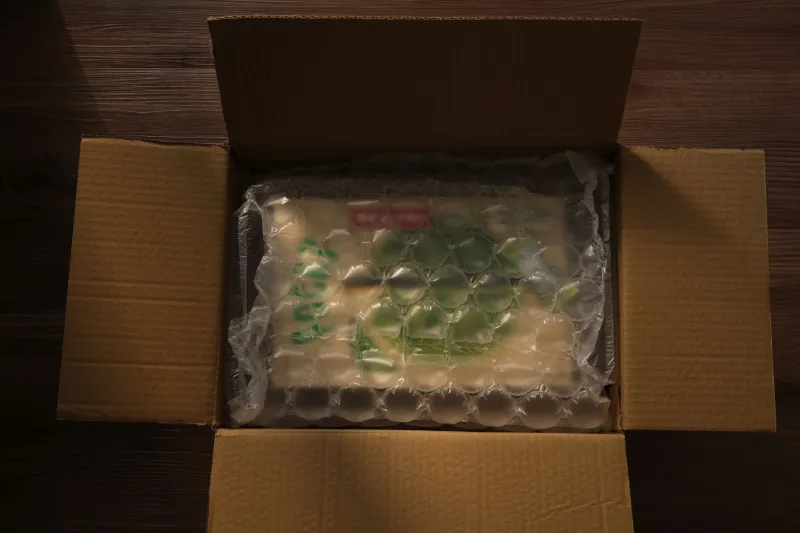
Peak-season sorting is less gentle than the rest of the year. Parcels are scanned, tipped, stacked and occasionally used as a temporary table. A small painting needs a proper sandwich: glassine or acid-free tissue against the surface, foam board either side, corner protectors, then an inner box. That box goes into a slightly larger outer box with at least five centimetres of cushioning on every side. Loose polystyrene peanuts are fine as void fill, but they should not press directly against a frame or a canvas edge. Use strong tape on every seam and write the buyer's address clearly on the outside as well as on the label.
Fragile labels are useful, but they are not a magic spell. Neither is a signature on the door. It proves someone was there, not that the box was treated like a sleeping cat. Photograph the packed parcel before it leaves the studio, and keep the tracking number in the same place as the invoice. If the work is framed under glass, think hard before posting it in December. Glass can be replaced, but the disappointment is harder to fix. For higher-value pieces, a specialist fine art courier or a hand-delivery arrangement may be the kinder option.
What 'guaranteed' actually means
Most express services guarantee delivery by a certain time on a working day, subject to exclusions. Compensation is often limited to the postage cost unless you buy extra cover. Read the small print before you promise anything to a buyer. If the painting is worth several hundred pounds, the basic cover may not be enough. Keep proof of postage, keep the receipt for any additional insurance, and know the claims window. It is usually shorter than the time it takes to recover from the festive season.
Collectors should also ask what happens if the parcel arrives damaged. Open it carefully, photograph the packaging before you pull everything apart, and keep the box until you are sure the work is fine. A quick photo of a crushed corner is worth more than a long paragraph of complaint later. If you are buying from an artist, ask which service they use and whether the work is insured in transit. A good artist will not mind the question. It is part of buying original work rather than a mass-produced print.
The email that saves the relationship
Sometimes a parcel is delayed. The carrier's tracking page goes quiet, the buyer sends a polite but pointed message, and you feel the urge to hide under the desk. Do not hide. Send an update before the buyer has to chase you. Be specific: what was dispatched, when, with which carrier, what the tracking currently says, and what you are doing next. Offer a revised expectation rather than a vague reassurance. If the piece will not make Christmas, say so clearly and offer options: a refund, a substitute work, or delivery in the new year with something small thrown in as an apology.
For collectors, the same courtesy works both ways. Confirm that someone will be in to receive the parcel, give a safe place only if it is genuinely safe, and check the tracking rather than assuming the worst on day one. A delay handled well can actually strengthen trust. It shows that the person on the other end is paying attention.
A few UK practicalities
Postcodes matter. The Highlands and Islands, Northern Ireland, the Isle of Man and some rural areas can add a day or more to any service. The Channel Islands sit outside the UK parcel network in ways that surprise people every December. If you are sending to a workplace, check the opening hours over the Christmas break. If you are buying, tell the artist about any concierge, gate code or neighbour arrangement before dispatch. And if collection from the studio is an option, use it. A handover with a cup of tea is the most reliable delivery service in the country.
The parcel is part of the provenance now. Keep the packing photos, the tracking details and the emails. A painting that arrives calmly carries that calm into the room. That is worth a little planning in the second week of November.