The Four O'Clock Problem: Judging a Painting When the Sun Clocks Off Early
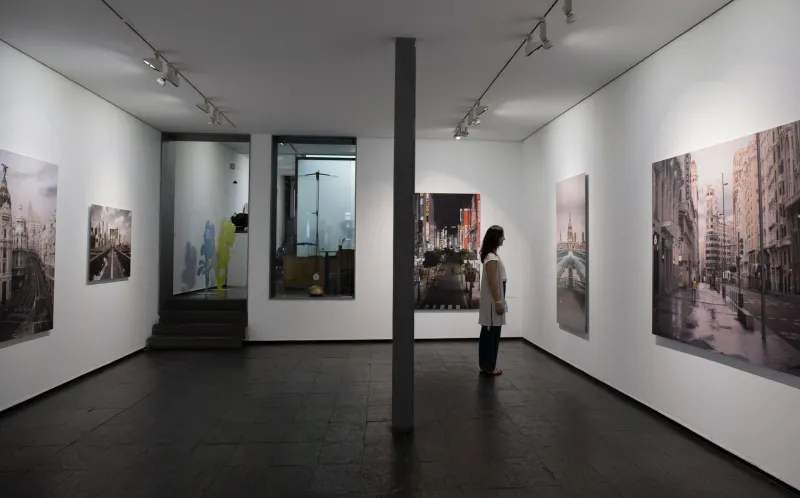
Winter is a funny time to fall for a painting. You step in from a slate-grey afternoon, coat still damp, and the gallery feels like a warm little stage set. The spots are on, the walls are clean, and every canvas looks as if it has just been unwrapped. Then you get it home, hang it in the front room, and wonder why the sky has gone slightly mauve.
I have watched this happen from both sides of the easel. In the studio, a picture can look perfectly judged at 2pm and distinctly sulky by 4.30pm. In a viewing room, the reverse happens: the lighting does the heavy lifting and the buyer sees a more theatrical version of the work than the one they are actually taking home. Neither experience is dishonest, exactly. It is just winter light, and the lamps we use to argue with it.
If you are buying original art between November and February, the aim is not to become a lighting technician. It is simply to see the painting under more than one version of the truth.
The room is wearing the painting's costume
Gallery spotlights are designed to make work look good. That is their job, and most of the time they do it well. But a warm 2700K bulb will flatter reds, ochres and varnished surfaces while quietly muting blues. A cool, bright LED can make whites look crisp and contemporary, then leave skin tones slightly grey. Neither is a scandal. The problem comes when you mistake the lighting for the artwork.
Before you start falling in love, ask the simple question: could I see this nearer the window with the overhead lights off? Most galleries, framers and open studios will happily move a piece or dim a bank of spots. If the answer is a firm no, that is useful information too. You can still buy, but you should know you are judging a performance rather than a rehearsal.
Daylight is not always generous, but it is honest
A British winter window is not a magic portal to perfect colour. It may give you flat grey light, a cold north-easterly wash or five minutes of low golden sun that turns everything amber. That is fine. The point is variety. Look at the painting in the window light, then step back into the room light, then look again. Which version feels closest to the work you actually want to live with?
Try to compare whites. Hold a sheet of ordinary white paper or a cotton handkerchief near the edge of the canvas. Does the painting's white look creamy, chalky, blue-white or almost pink? This matters more than collectors sometimes admit. A white that sings under a warm bulb can look dull in a north-facing bedroom. A white that looks cold in the gallery may settle beautifully in a brighter kitchen.
Shadows are just as revealing. Under a single spotlight, shadows can collapse into soft grey puddles. In daylight, you may suddenly see the structure: the cool violet under a table, the green in a black coat, the warm brown in a shadow that looked merely dark. If those subtleties delight you, good. If they make the painting feel muddy, believe your eyes.
Your phone torch is not a gallery
Phone torches are brilliant for finding keyholes and terrible for judging art. They are harsh, uneven and usually much cooler or warmer than they appear. A quick flash of torchlight can make a surface look glossy, flatten impasto or exaggerate texture in a way that has nothing to do with the painting's character. Use your phone to photograph the label and the price list, not to conduct a colour critique.
If you need extra light, ask whether the seller has a neutral daylight lamp. Something around 5000K to 6500K is closer to overcast daylight and will give you a fairer look at colour temperature. It will not replace a window, but it is a more useful second opinion than the torch on your keys.
Look at the edges, the glass and the varnish
Winter viewing is also a good time to check the practicalities. Stand at an angle and look across the surface. Does the varnish catch the light in patches? Is there glass on the frame, and if so, is it creating reflections that hide the brushwork? A non-reflective glass can be a blessing in a dark room, but it can also mute the painting's depth. Ask what you are actually seeing.
Look at the edges of the canvas or panel too. A painting that seems rich in the centre may have thinner, sketchier passages near the border. Under warm light, those passages can blend in. In flatter daylight, they may become more obvious. Neither is automatically a fault, but you should know what you are buying.
The revisit rule
If you are spending serious money, see the painting twice. Ideally, view it at different times of day: once in the morning and once in the late afternoon, or once in daylight and once under the gallery's evening lighting. If a second visit is impossible, ask for a short hold and return with a friend whose eyes you trust. Fresh company often catches what infatuation misses.
Take a photograph by all means, but treat it as a memory aid rather than evidence. Phone cameras auto-correct colour, brighten shadows and sharpen edges. The photo will tell you what the painting looked like on a screen. It will not tell you what it will look like above your sofa on a wet Tuesday in January.
A simple winter buying checklist
- Ask to see the work near a window with the spotlights off.
- Compare the painting's whites with a plain white sheet of paper.
- Look at shadows in both warm and cool light. Do they keep their structure?
- Step back at least three metres and check the painting as a whole.
- View it at eye level, then slightly above and below. Reflections change with height.
- Ask about varnish, glass and the recommended hanging light.
- Take a photo for reference, but do not trust it for colour.
- Revisit within a week if you can, ideally at a different time of day.
- Ask for the price list, condition notes and any care instructions in writing.
Winter is not the enemy of good art. It is simply a stern editor. A painting that holds up in grey November light, under a neutral lamp and beside a window with the rain coming sideways will usually hold up anywhere. A painting that only works under a hot spotlight may still be a wonderful thing, but it is a stage set. Know which one you are taking home.
And if you do fall for something at four o'clock on a dark afternoon, that is allowed. Just go back and look again when the sun has had another go at it.