The Village Hall Test: Showing Work Beyond the M25 Without Losing Your Nerve
The first thing I noticed was the draught. The second was the tea urn. The third was that nobody seemed remotely bothered by either.
I had been invited to take part in a small pop-up exhibition in a village hall — the kind of building with a stage at one end, a noticeboard by the door, and a kitchen that smells faintly of biscuits. It ran for one weekend this autumn. No white cube, no professional lighting rig, no private view with a guest list. Just borrowed rails, a few dozen paintings, and a lot of conversations with people who had never bought original art before.
It was, in its own quiet way, one of the most useful shows I have done.
The hall itself: borrowed rails and draughty corners
Village halls are not designed for art. They are designed for jumble sales, parish council meetings, keep-fit classes and the occasional wedding. That means you inherit whatever the building gives you: strip lights, radiators, fire doors, a piano, and a stage curtain in a shade of maroon that flatters nothing.
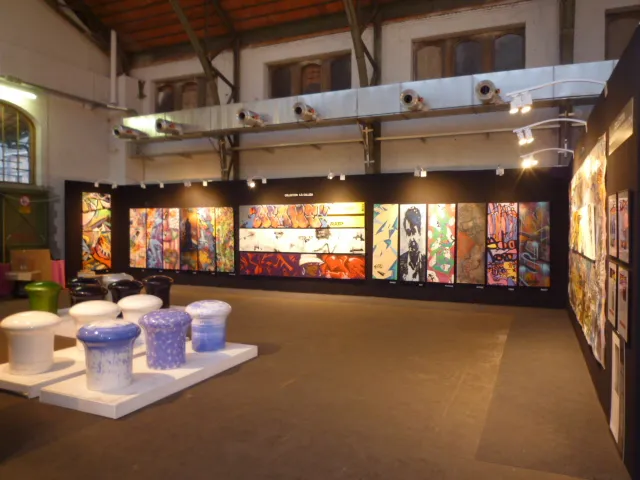
The practical answer is to work with the room rather than fight it. We borrowed freestanding display rails from a local arts group and used them to create a rough corridor of work, which stopped visitors from seeing everything in one glance. A couple of tall plants — genuinely useful, not just decorative — softened the corners. We covered the worst of the noticeboards with plain cloth. The strip lights stayed on, but we added a few battery-powered picture lights over the strongest pieces so they had a bit of presence.
If you are planning something similar, check the basics before you fall in love with the room: power sockets, ceiling height, whether you are allowed to fix anything to the walls, and what time you can get in to set up. Ask about parking, accessibility, and whether there is a kitchen you can use. A hall with a good kitchen is a hall that can host a conversation.
Hanging a room that wasn’t designed for art
My approach was ruthless: fewer pieces, more space. In a hall, clutter is the enemy. I hung the largest work on the end of a rail where it could be seen from the door, kept small works at eye level, and resisted the urge to fill every gap. Labels were simple — title, medium, price, and a short note about the idea behind the piece. Nothing fancy. People read them more closely than you might expect.
The unexpected bonus of a draughty hall is that it slows people down. There is no rush, no fair-floor sprint. Visitors tend to walk the room, then come back. That gives you a second chance to talk to them, which is where most of the real work happens.
Pricing chats with first-time buyers
I had several versions of the same conversation over the weekend. Someone would look at a painting, then at the price, then back at the painting. I learned to let the silence sit rather than jumping in with a discount.
What helped was being clear about what the price included: the frame, the hanging materials, a care sheet, and the fact that the work was original and one of a kind. For first-time buyers, the gap between a print and an original can feel enormous. It helps to explain the difference without being precious about it. I also had a small basket of unframed studies at lower prices, which gave people a way in without making the main work feel cheapened.
One buyer asked whether she could pay in instalments. I said yes, and we agreed a simple schedule in writing. Another asked if I would hold a piece until payday. Also yes. Small shows run on goodwill, and a bit of flexibility is often more valuable than a rigid price list.
What I’d do differently next time
I would bring a card reader with a stronger signal — or at least a clear sign saying what payment methods worked. I would print more care sheets than I thought I needed. I would also take a proper break. By Sunday afternoon I was answering the same question about varnishing in three different ways, which is a sign I needed a cup of tea and ten minutes outside.
And I would take more photographs of the room before the doors opened. Not for social media, but for my own notes. It is easy to forget how a space actually looked once the people arrive.
A practical checklist for artists
- Confirm setup and pack-down times in writing.
- Ask about wall-fixing rules, power, lighting and accessibility.
- Bring your own hanging kit, scissors, tape, labels and a small tool box.
- Price everything clearly and keep a simple stock list.
- Have lower-priced studies or prints for first-time buyers.
- Take a card reader, a cash float and a notebook for contacts.
- Print care sheets and a sign-up sheet for your newsletter.
- Check public liability insurance and any local authority requirements.
- Bring a flask. You will be there longer than you think.
If you’re buying at a small show, ask this
Ask what the work is made with and how it should be cared for. Ask whether the frame is included. Ask if the price is fixed or whether the artist offers payment plans. Ask how the work should be hung and whether it is ready to go straight on the wall. And ask the artist what they were thinking about when they made it — not to test them, but because it is usually the most interesting part of the conversation.
Small shows are not a lesser version of city fairs. They are a different room with a different rhythm. If you turn up with a bit of preparation and a willingness to talk, a village hall can teach you plenty.